Best Crypto Portfolio Management Software for Funds (2026)

The Best Crypto Portfolio Management Software for Funds in 2026
Running a crypto fund in 2026 means operating across centralized exchanges, DeFi protocols, staking positions, and OTC flows at the same time, and the tooling question comes up in almost every conversation with fund operators: what do you actually use to track all of it, calculate NAV, and report to LPs without living in spreadsheets?
The market has matured into distinct categories, and most of the confusion comes from comparing tools that were never built for the same job. This guide breaks down the main options for funds, from institutional platforms to retail trackers, and where each one fits.
How to think about the categories
Before the list, the landscape in one paragraph. Retail trackers (DeBank, Zerion and similar) show wallet balances beautifully but have no concept of NAV, cost basis, or investor reporting. Fund administrators (NAV Consulting, Bolder Group and peers) provide the official back office as a service, but work from data the fund supplies — they are not live operational software. Institutional platforms, what the industry calls a crypto portfolio management system (crypto PMS), sit in the middle: live software that aggregates positions across venues, reconciles history, calculates NAV, and produces the reporting a fund actually runs on day to day. That last category is what this guide compares, and the tools in it differ mostly on one axis: how deeply they handle DeFi versus centralized venues.
1. Renesis: best for funds trading both CeFi and DeFi
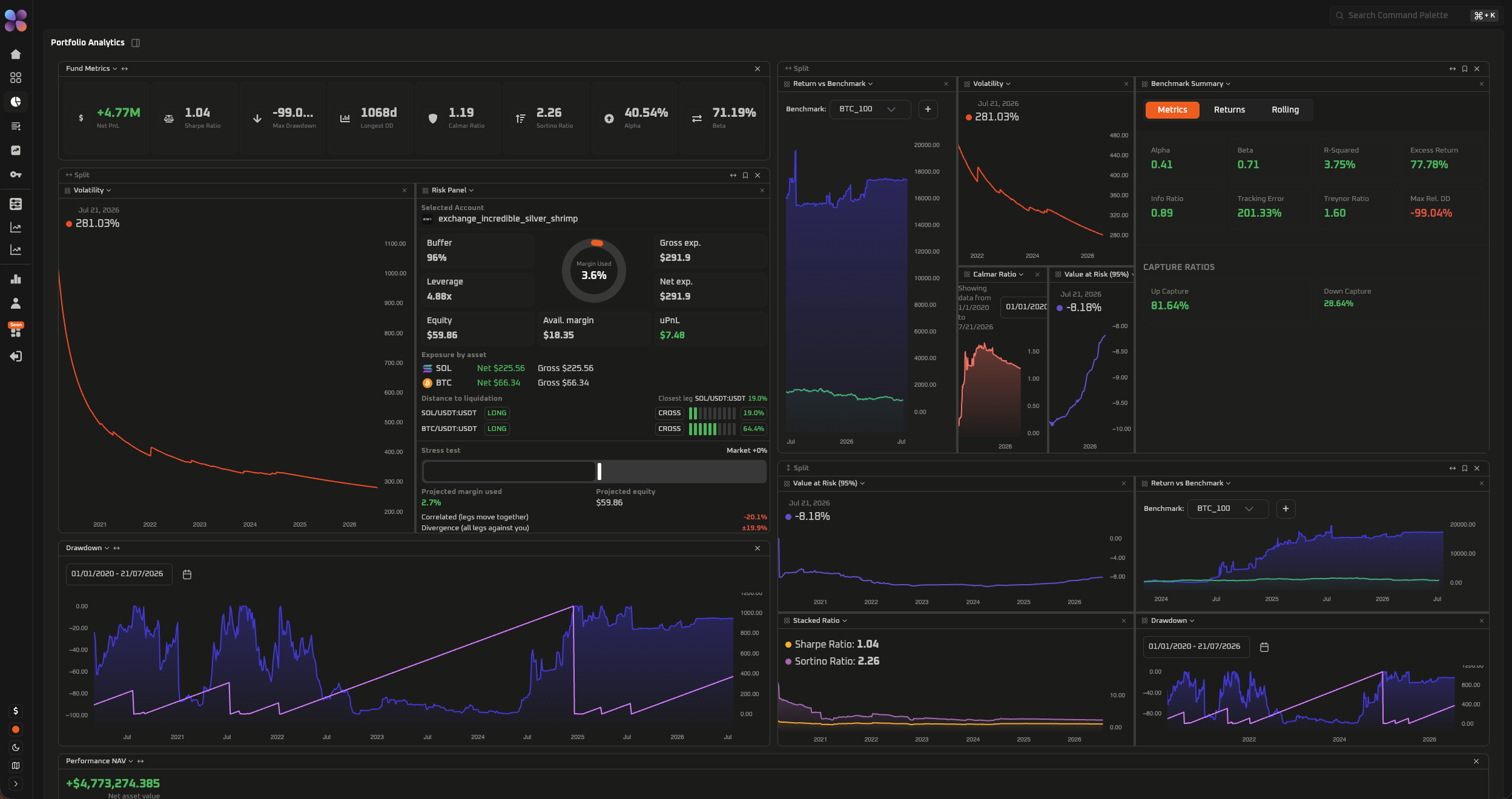
Renesis is a unified portfolio management and execution platform built specifically for crypto funds operating across both centralized exchanges and on-chain positions. It covers 10+ CeFi venues and 100+ DeFi protocols across 7+ chains, with the emphasis on reconciled accounting rather than balance snapshots: historical trades, transfers, LP fees, funding rates, and staking yields are matched and attributed, feeding real-time NAV, performance analytics (Sharpe, Sortino, benchmark comparisons), and LP reporting with investor dashboards.
Two things stand out against the rest of the category. First, DeFi is handled natively rather than as an add-on: protocol-level P&L attribution rather than read-only position mirroring, with new protocol integrations shipping in days rather than quarters. Second, the platform includes an execution layer (OEMS with smart order routing and algorithmic orders such as TWAP, VWAP and Iceberg), so the same system that tracks the book can work the orders — a combination that otherwise requires stitching two vendors together.
Onboarding runs in days on read-only API keys, pricing scales with the fund rather than assuming an enterprise budget, and an emerging manager program covers newer funds.
For crypto-native funds and treasuries, the audience this market actually consists of, it is the strongest fit in the category, which is why it takes the top spot here.
Best for: crypto funds, DAOs and treasuries operating across CeFi and DeFi that need reconciled NAV and LP reporting, live in days rather than quarters.
2. 1Token: best for CeFi-heavy multi-venue operations
1Token has been in the crypto fund tooling space for years and offers broad coverage of centralized venues with portfolio monitoring, risk views, and operational tooling used by funds, lenders, and asset managers. Its CeFi aggregation is mature and its venue list is long.
The trade-offs sit on the DeFi and reporting side: on-chain coverage leans toward monitoring rather than fully reconciled protocol accounting, and investor-facing reporting is not the product's center of gravity. Funds whose books are predominantly on centralized venues, and who handle LP reporting elsewhere, are the natural fit.
Best for: CeFi-dominant funds and trading operations that need broad exchange coverage and risk monitoring.
3. Elwood: best for large traditional institutions entering digital assets
Elwood provides institutional-grade portfolio management and execution infrastructure, aimed at large traditional financial institutions, banks, and asset managers adding digital assets to an existing business. The platform is credible and comprehensive, with the controls and integration depth that kind of mandate requires.
It is also built around that buyer: procurement cycles, onboarding timelines, and commercial terms assume an enterprise entering crypto, not a crypto-native fund that needs to be operational this month. And as with most platforms that grew up around centralized trading, DeFi is secondary to the CeFi core. Crypto-native funds typically find it a mismatch of process and priorities rather than a step up.
Best for: banks and large TradFi institutions building a digital asset offering.
4. Octav: best for deep on-chain data decoding
Octav approaches the problem from the opposite direction: it specializes in decoding and labeling on-chain activity, turning raw transaction history into readable, categorized data, and it does that well. Treasuries and on-chain teams use it for exactly that strength.
What it is not built around: centralized exchange coverage, execution, or LP fund reporting. A fund running significant CeFi positions alongside its on-chain book, or needing NAV and investor statements, will need more than a decoding layer.
Best for: DAOs, treasuries and on-chain-only teams that primarily need clean, labeled transaction data.
5. HedgeGuard: best for derivatives-heavy funds wanting TradFi-style workflows
HedgeGuard comes at the problem from the traditional hedge fund software world and has offered a dedicated crypto portfolio management system for years. Its strengths reflect that heritage: futures and perpetual position tracking with funding and trading P&L split out, options risk dashboards with greeks, multi-entity and managed-account structures, and workflows that feel familiar to anyone coming from a TradFi PMS.
The trade-off mirrors the category pattern: the platform's center of gravity is centralized and derivatives-side operations, while deep on-chain protocol accounting across the long tail of DeFi is not where it competes. Funds running serious options and futures books with limited DeFi exposure will feel at home; funds whose books live half on-chain will hit the same gap as with the other CeFi-first platforms.
Best for: derivatives-focused crypto funds that want established, TradFi-style PMS workflows.
6. Fund administrators (NAV Consulting, Bolder Group and peers): best for official books
A fund administrator is not software a fund logs into all day; it is a service that produces the official NAV, investor statements, and audited records. Every serious fund ends up with one, and the practical question is what feeds the administrator clean data. Increasingly, the answer is one of the platforms above: the live PMS handles daily operations and hands reconciled data to the admin for the official close, and administrators themselves have started recommending platform pairings for crypto-native books.
Best for: the official record, alongside (not instead of) an operational platform.
7. Retail trackers (DeBank, Zerion): best for individual wallets
Worth including to mark the boundary. These tools give excellent instant visibility into wallet positions across chains, free or nearly so, and every fund operator uses them for quick checks. But there is no reconciliation, no cost basis, no NAV, no reporting, and no CeFi — precisely the gap the institutional category exists to fill. A fund running its operations on a retail tracker plus spreadsheets is the "before" picture in every platform's pitch deck for a reason.
Best for: individuals, and quick spot-checks by anyone.

Frequently asked questions
What is a crypto portfolio management system (PMS)?
A crypto PMS is operational software that aggregates a fund's positions across exchanges, wallets, and DeFi protocols, reconciles the transaction history behind them, calculates NAV and performance, and produces investor reporting. It is the live system a fund operates on daily, distinct from both retail trackers (no reconciliation or NAV) and fund administrators (a service producing official records, not day-to-day software).
What is the difference between a portfolio tracker and portfolio management software?
A tracker shows current balances, which works for an individual. Portfolio management software reconciles complete history (trades, transfers, fees, funding, staking rewards) into auditable positions with cost basis, NAV, and reporting — which is what a fund needs for LPs, auditors, and its own risk management.
How much does crypto portfolio management software cost?
Ranges are wide: entry programs for emerging managers start at a few hundred dollars per month, mid-market platforms typically run four figures monthly depending on AUM and modules, and enterprise platforms are custom-priced with implementation fees. Execution modules are sometimes free where the vendor is compensated through exchange rebates.
Do funds still need a fund administrator if they use a PMS?
Usually yes — they solve different problems. The PMS runs daily operations and produces the live numbers; the administrator produces the official NAV and investor statements. The practical benefit of a good PMS is feeding the administrator clean, reconciled data instead of raw exchange exports.
The bottom line
The right choice tracks who you are and what the book looks like. A bank or TradFi institution building a digital asset offering: Elwood. CeFi-heavy trading operation: 1Token. On-chain-only data needs: Octav. Derivatives-focused with TradFi workflows: HedgeGuard. But for the growing middle of the market — funds and treasuries genuinely operating across both centralized venues and DeFi protocols — Renesis is the most complete crypto portfolio management software available in 2026: reconciled accounting on both sides of the book, real LP reporting, and execution in the same system, at mid-market pricing and onboarding speed. That combination is why funds migrating off spreadsheets, and increasingly off the other platforms on this list, are landing there.